hen
James Douglas Logan was born in Berwickshire in 1857, he
was already a child of the industrial age which had begun some 70
years previously with the building of factories, canals, railways
and mighty steam engines. By the mid 1800s, Britain was at the height
of her industrial and commercial power, opportunities abounded for
the young entrepreneur. Australia, America, India and a plethora
of British outposts around the world beckoned the young from all
backgrounds, and Logan decided to by his luck in Australia. And,
while on his way there by ship, was to travel no further than The
Cape of Good Hope where his ship was wrecked.
Adversity was but a challenge to the young entrepreneur, Logan,
who, with just a few pounds in his pocket, needed a "start".
In his teens, Logan had worked as a clerk on the North British Railways,
and naturally this was presented as a reason for his being hired
as a porter at the new Cape Town Railway Station.
ogans'
early history is similar to hundreds of other British entrepreneurs,
both then and now: mediocre beginnings overcome by dedication to
progress, these people are always controversial - and Logan was
no different. Logan would have been very aware that he needed to
acquire some influence even if in some small measure, and he managed
to become the station master at Cape Town. This ensured that he
would meet people who could be helpful to his intentions both within
the railway community and onward to the emerging South African commercial
leaders. Logan's next step was to become District Superintendent
of the Touws River to Prince Albert Road section.
As with most budding entrepreneurs, Logan knew that to achieve
personal wealth he would have to establish himself in business.
The idea of living from wages for more than a few years while he
established himself would not have been part of his plans.
he
history of all entrepreneurs has many common threads. The
time of Logan's rise to prominence, Britain led the world in all
areas of design and railway construction and with it pioneered many
new related opportunities. Described as "God's Wonderful Railway",
it carried the fastest trains in the world (London to Bristol line
1840). The achievement has been described as "a work of art
and it works". The rest of the world followed, but the historic
pioneering works of the Industrial Revolution are mostly within
Britain and her Colonies.
Logan was a man of his time. He would have been energised in his
dedication by constant reports from Britain of yet more great achievements
within the commercialisation and exploitation of "this great
work of art." Today, we see the same opportunities offered
by information technology; and, in the 1970s, air travel spawned
its share of entrepreneurs. Each industry of the generation creates
its own J.D. Logans. 
hile
acting as District Superintendent for his area, Logan would
have constantly observed opportunity. The great railways of Britain
and America had begun catering to the needs of its passengers, the
emergence of the famous Pullman American "dining cars"
being one example. In Britain, less sophisticated catering facilities
were available. Thomas Cook, the
inventor of Travel Agencies, had ensured that catering was included
for his customers.
ogan
resigned from the Cape Government Railways, bought a hotel
in Touws River, and a wholesale wine and spirit store in Cape Town.
Doubtless, Logan had carefully researched his "new product"
and would have assured himself of acquiring the crucial customer
base prior to investing. The acquisition of the wine and spirit
store was a strategic purchase, enabling him to supply the Cape
Town market, while decreasing the cost of supply to his new hotel.
Logan was the archetypal entrepreneur. His core product was a necessity;
he understood mass transportation; and he also understood the importance
of new product development one hundred years prior to it being a
marketing requirement. He understood the importance of creating
the Logan brand.
When the opportunity arose to acquire a tin-shed and a huge area
of land for just 400 pounds, he seized it very quickly. Why? Simply
because it had a railway running through it! And that meant sustainable
income.
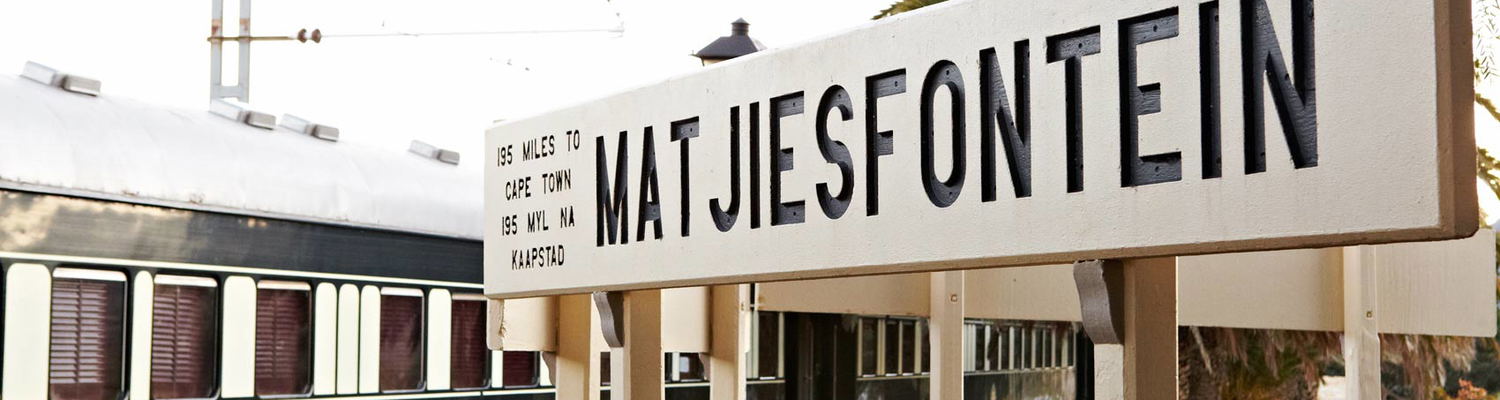
Detailed stories exist describing Logan's planning and building
at Matjiesfontein, his many "firsts" and his talent for
marketing. For that was what Logan was - the consummate marketing
man (as opposed to salesman) some 100 years before the term "marketing"
meant anything more than fruit and vegetables being sold on "market"
day in a Village.
Logan knew the vital importance of attracting "quality people"
to his venue. He knew that he had to cater to those who had not
only money but people who could spread the "brand" worldwide.
n
November 1889, at the opening of the Matjiesfontein Water Works,
where Logan displayed his wonderful capability to provide interesting
and varied entertainment, one of his guests, Colonel Schermbrucker,
declared that Logan had made a paradise in the desert. Logan replied
that "it was not that he had done so much in the Karoo but
that others had done so little". This is true of many entrepreneurial
endeavours: so many sit and watch but do not see; others see but
do not do. Just a few transfer the thought into action.
The more dedicated pioneers in any walk of life are always to be
found in the company of their peers. What takes perhaps weeks to
explain to those with less agility of thought is understood by the
entrepreneur in seconds, which often leads to fear of the quicker
mind without comprehension of the opportunity. Most great entrepreneurs
are dogged by litigation, and Logan was no different. Logan was
the most litigious person of his age in the Cape Colony, still famous
among legal circles in Cape Town. Logan joins entrepreneurial history
along with more recent examples such as Richard Branson and British
Airways, Freddie Laker and several banks. The pathway to the achievement
of great things is littered with litigation, usually created by
those who would not achieve themselves but would prevent others
simply to protect a historic advantage. 
n
1892, Sir James Sirewright, Minister of Railways, gave the
catering contract to his friend Logan without calling for tenders
or informing the other railway hierarchy. This action created such
a storm that it caused Rhodes to dissolve and re-form his ministry.
Sirewright, Merriman and Saver resigned, and Logan then sued the
Government and won. Recognising that he needed to cater for several
types of clientele, Logan offered a range of refreshments. Today,
the mineral water business has become
a worldwide phenomenon, but Logan had developed the Matjiesfontein
mineral water factory (which lasted many years) in the late 1890s.
 |
| THE HOME OF J.D.
LOGAN'S GRANDSON STILL RESIDING IN MATJIESFONTEIN |
fter
Logan's death in 1920, Matjiesfontein was tended by his family,
his son Mr. James Douglas Logan
and his daughter, wife of Colonel H.J.
Buist, who stayed on at Matjiesfontein. And so it was to
remain for many years until another entrepreneurial spirit appeared
in the guise of Mr. David Rawdon,
hotelier extraordinaire, visionary and highly skilled interior decorator.
avid
Rawdon came from a family of entrepreneurial spirit, and
many parallels exist between the Logans and the Rawdons, not least
of which is the ability to "spot opportunity". David Rawdon's
uncles had, through their own hard work, become lawyers during the
prohibition period in America, where they were kept busy defending
errant clients. David Rawdon's autobiographical note in the book
"Logan's Way", by Robert
N. Toms, well describes the early days of this talented man,
starting out with a mobile store. Rawdon displayed the same focus
and dedication as did Logan.
Once again, the hospitality industry was to call David Rawdon.
From his mobile store, and through hard work, David multiplied his
money, eventually going into business with his brother Graham to
open the famous Rawdon's on Noltingham Road. Its official title
was The Noltingham Road Hotel, but it really was (and is) Rawdon's.
Like most entrepreneurs, David displayed the ability to make up
his own mind - sometimes against "all good advice". When
the Rawdons were building The Noltingham Road Hotel, David's father
died suddenly of a heart attack. Family friends tried earnestly
to dissuade David's mother from carrying on with "the folly",
but to no avail. David was even more determined to succeed, and
succeed he did!
any
icons of the hospitality industry in South Africa have been
"touched" by David Rawdon, such as the Lanzerac,
and The Marine Hotel. His interior
design work is legendary, but Matjiesfontein will always be where
his heart lies. David Rawdon purchased Matjiesfontein during the
late 1960s, and, after detailed and loving restoration work, David
re-opened Matjiesfontein in 1970.
David Rawdon, the kindred spirit of Logan, once again allowed Matjiesfontein
to offer the best in hospitality to an eclectic mix of visitors.
Once again, great names of the age visited the Village.
n
1979, Matjiesfontein was declared a National Heritage Site,
a tribute to Logan and to David Rawdon whose love and dedication
to Matjiesfontein allowed it to live again.
oday,
on the eve of another great millennium,
with David Rawdon reaching his golden years, Matjiesfontein
joins the electronic age, a new age for South Africa. Will the
entrepreneurial spirit continue? Will the spirit of J.D. Logan
and David Rawdon be continued into the new millennium? Somewhere
out there is yet another entrepreneur, visionary and provider
of the love that is Matjiesfontein's future. He may have some
time to wait: David Rawdon still has some exciting ideas for
Matjiesfontein. They may keep him busy for years to come. |
|